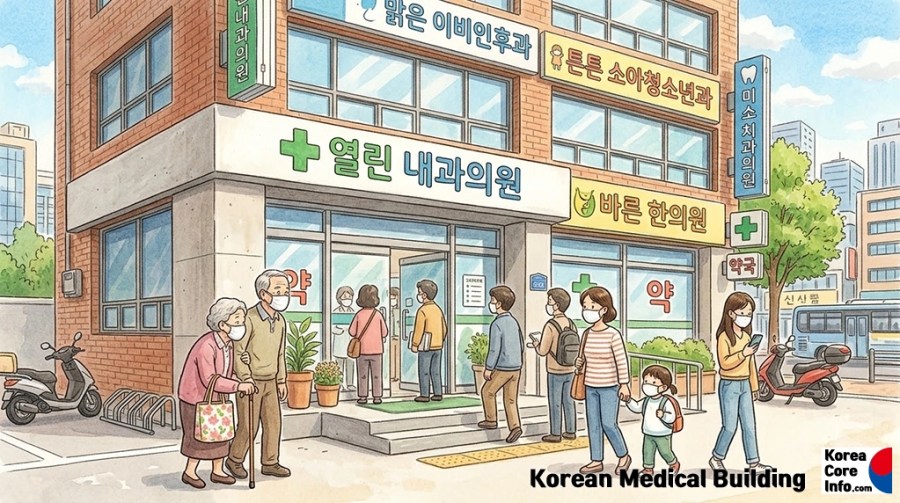
Seeing a doctor for an ordinary illness in Korea often begins with a neighborhood clinic rather than a large hospital. In many commercial areas, it is common to find several independent clinics in the same building, sometimes with a pharmacy on the ground floor or nearby.
This is a familiar part of everyday life for me. For a routine visit, I usually find a nearby clinic, check its opening hours, go to the reception desk, wait for my turn, see the doctor, and then take the prescription to a pharmacy. The whole process involves relatively few steps, although the actual waiting time varies depending on the clinic and how busy it is.
For someone visiting Korea for the first time, the system can look a little unfamiliar. Understanding the difference between a neighborhood clinic, a larger hospital, and the pharmacy next door makes it much easier to use.
Why One Building Can Have Several Different Clinics
In Korean cities, several independent medical practices often occupy different floors of the same commercial building. One floor might have an internal medicine clinic, while another has an ENT clinic, orthopedics, dentistry, ophthalmology, pediatrics, or another specialty.
People sometimes informally call this kind of place a “medical building,” but it is not one hospital containing all of those departments. Each clinic is normally a separate business with its own doctor, reception desk, opening hours, and patients. The pharmacy in the same building is also an independent business.
This arrangement can be convenient because different kinds of outpatient care are concentrated in one neighborhood. If I need to find a clinic I have not visited before, I often check its location, hours, and lunch break on Naver Map, which is one of the ways I use the app described in my Korea Travel Apps guide.
Not every medical building looks the same, and not every clinic offers the same tests or facilities. Some are very small practices, while others can perform blood tests, urine tests, X-rays, or other examinations without sending the patient to a larger hospital.
What a Routine Clinic Visit Looks Like
For ordinary outpatient care, many neighborhood clinics accept patients without an appointment, although individual clinics may have their own reservation policies. Popular practices can become busy in the morning or after lunch, so sometimes I have waited only a short time and on other occasions much longer.
At one of my recent routine visits, I checked in at the reception desk, verified my identity, and waited until my name was called. The doctor reviewed my recent condition and previous results, asked questions, and discussed whether anything needed to change before issuing my prescription.
Since May 2024, identity verification has been required when receiving care covered by Korea’s National Health Insurance. Patients can use accepted identification such as a resident card, driver’s license, foreign residence card, or the Mobile Health Insurance Card. Foreign residents should preferably carry a residence card, since a passport may not always contain the information needed for National Health Insurance verification. Exceptions apply in situations such as emergency care and treatment for patients under 19.
This does not mean every consultation in Korea follows exactly the same pattern. The length of the visit depends on the condition, the doctor, and what needs to be checked. What feels convenient to me is that common outpatient care is often available close to home without having to begin at a major hospital.
From the Clinic to the Pharmacy
After the consultation, I usually receive a prescription and take it to a nearby pharmacy. Pharmacies located in the same building or next door are convenient, but they are not part of the clinic itself.
You are not required to use the closest pharmacy simply because it is downstairs. You can take the prescription to another pharmacy, although not every pharmacy will necessarily have every prescribed medicine in stock.
One detail I have always found useful is the information that can come with the medication. At a pharmacy I have used, the medication bag included pictures of the pills, their names, dosage instructions, and simple warning information. The exact format differs by pharmacy and computer system, but it can make it easier to check which medicine should be taken and when.
My older pharmacy bag is a good example. Along with the medicine itself, I received printed information showing the appearance of each pill and the schedule for taking it. The pharmacist also explained the medication verbally when handing it over.

What Foreign Visitors Should Know
Foreign residents enrolled in Korea’s National Health Insurance use the same covered health benefits as Korean citizens. The National Health Insurance Service provides separate guidance for foreign residents explaining eligibility and coverage.
Short-term visitors who are not enrolled in Korean National Health Insurance can still visit clinics, but they should expect to pay the medical bill themselves and use travel insurance if their policy covers the treatment. Costs vary depending on the clinic, tests, treatment, and medication, so I would not assume that every visit will cost the same amount.
Language ability also varies considerably from clinic to clinic. Some doctors and staff can communicate comfortably in English, particularly in areas with many international residents or tourists, while others may use very little English. Having the name of your symptoms, medication, or medical condition written down can make communication easier.
For a serious emergency, I would not spend time searching for a neighborhood clinic. Korea’s emergency number is 119, and emergency care should be treated differently from the ordinary walk-in clinic experience described here.
Why Neighborhood Healthcare Feels Convenient to Me
What I find most convenient about neighborhood healthcare in Korea is not a dramatic medical technology or an unusually complicated system. It is the fact that when I need ordinary outpatient care, there is often a clinic reasonably close by, followed by a pharmacy where I can pick up the prescribed medicine.
That experience should not be confused with the entire Korean healthcare system. Emergency medicine, serious illnesses, surgery, regional healthcare shortages, and highly specialized treatment involve very different issues, which I discuss separately in my South Korea Healthcare System Guide.
For ordinary medical visits, what stands out to me is how easily neighborhood clinics and pharmacies fit into everyday life. After living with this system for a long time, it is one of the practical details of Korea that I tend to notice most when explaining daily life here to someone who has never used it.
About the Author 🇰🇷
I live in South Korea and write about the small details of Korean life and culture that I experience and observe firsthand.
English is my second language, so I sometimes use tools such as Gemini and Google Translate to help with translation and editing. The experiences, observations, opinions, and cultural perspectives in my articles are my own, and I personally review and edit every article before publishing it.
My goal with Korea Core Info is simple: to share everyday Korea from a local perspective and help international readers discover things they might not always find in a typical travel guide.
I hope my stories and guides help you understand Korea a little better — not just as a place to visit, but as a place where people live their everyday lives.